
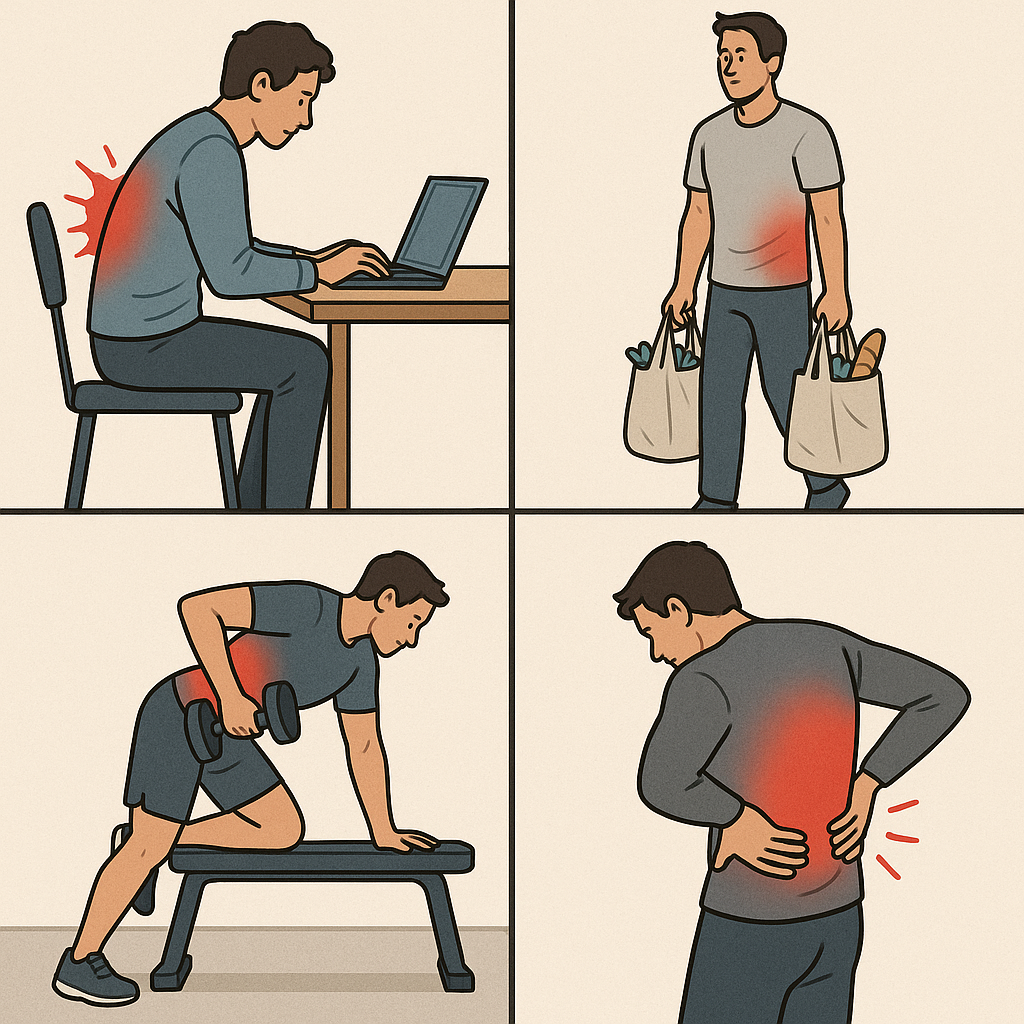
Discover the hidden demands your back faces every day and understand why a traditional clinic exam may miss the full picture of your spine's health.
What Your Back Is Really Doing All Day — and Why Your Clinic Exam Is Only Half the Story
One of the most frustrating experiences for people with chronic low back pain is being told, “Everything looks fine.” They’ve been examined, their range of motion is decent, and their strength looks okay. Nothing dramatic happens during testing—and yet, their pain persists, showing up during long workdays, repetitive tasks, or seemingly ordinary movements.
During my early training in physical therapy, I became deeply curious about why this happens. To find out, my research team and I studied people with chronic low back pain by setting them up with wearable motion sensors placed on their pelvis and lower back.
We looked at how they moved during a standard clinic exam and then compared it to how they moved in their everyday lives. This gave us rare, real-world data on how the spine actually moves outside the clinic—and why back pain can affect daily activity in ways we don’t always see in an exam room.
The Data Behind the “Snapshot” Problem
The core issue we discovered is that a clinic exam is a “snapshot” of movement. But your pain doesn’t live in a snapshot; it lives in the “movie” of your 24-hour day.
In our study, we used DorsaVi portable motion sensors to track spine movement. To capture the widest possible range of activity, we monitored each participant across both a weekday and a weekend day, measuring the frequency, magnitude, and duration of their spinal movements and postures.
To make the data meaningful, we first identified each participant’s specific painful movement in the clinic—for example, bending to the right, leaning forward, or extending backward. We then tracked how they interacted with that specific movement in the “wild.”
What we found was a wake-up call for how we evaluate pain:
-
The 2:1 Ratio: Participants favored one direction of movement over the other by at least a 2:1 ratio during daily life, often without realizing it.
-
Hidden Ranges: 33% of patients moved notably further into one or more direction during daily life than during their “maximum” clinical testing.
-
Invisible Asymmetries: 50% of participants showed side-to-side bending asymmetries that were completely undetected during standard exams.
-
Two Distinct Profiles: Most importantly, we found that patients fell into two opposite camps based on their identified painful movement:
-
Avoiders, who moved significantly less into their painful direction
-
Favorers, who repeatedly moved into their painful range or stayed in those positions longer throughout the day
-
The Two Profiles: Avoiders vs. Favorers
To understand why these patterns drive pain, we use the Physical Stress Theory (PST). Your spinal tissues—discs, ligaments, and muscles—need a “sweet spot” of stress to stay healthy.
Chronic pain happens when you fall out of that “Maintenance” zone into one of two profiles.
1. The Avoider (Under-Stressed)
The Avoider’s brain has become overprotective. Because movement once hurt, the brain now classifies it as dangerous. This leads to a measurable reduction in spinal movement—a finding recently corroborated by a 2025 study by Schömig et al., which found that people with chronic low back pain perform significantly fewer lumbar movements during daily life.
The Consequence:
By avoiding stress, tissues fall into the “Atrophy” zone, becoming weak and hypersensitive.
The Fix:
Graded Exposure. We slowly reintroduce movement to give the nervous system psychological permission to move, proving to the brain that the back is actually robust.
2. The Favorer (Tissues Are Over-Stressed)
Favorers often “push through” pain or have movement “blind spots,” unknowingly loading painful ranges more frequently than healthy individuals.
The Consequence:
Tissues remain in the “Injury” zone due to repetitive micro-trauma and a lack of recovery time.
The Fix:
Functional Integration. Because this behavior is often unconscious, the goal is to re-train awareness to halt the cycle of repetitive micro-trauma.
By learning to recognize these “blind spots,” the patient can purposefully redirect their movement toward healthier, more efficient patterns. This process involves consciously shifting the physical load to more tolerant structures—such as using the hips rather than the lower back—until these protective, healthy patterns become automatic again.
Testing Your “Automatic” Back: The LPM Assessment
Traditional tests ask you to move your back purposefully. But real life happens when you aren’t thinking about your back. This is where the Lumbar Protective Mechanism (LPM) comes in.
The LPM is your body’s “internal bodyguard.” It is an automatic system that should fire instantly to stabilize your spine before you even realize you need it.
The Test
In the clinic, we aren’t just looking for how strong your abs are; we are looking for your neuromuscular timing.
A Healthy LPM:
If I nudge your shoulder, your deep stabilizers fire in milliseconds. Your trunk stays rock-solid, and the force travels cleanly down into your feet.
A Dysfunctional LPM:
You “wobble,” buckle, or have a delayed response where you catch yourself only after you’ve already moved.
Why the LPM Matters for Real Life
Think about your day-to-day activities. These are the moments where a faulty LPM leads to a “tweak” or a flare-up:
-
The Curb Surprise: You’re carrying heavy groceries and step off a curb you didn’t see was so high. A healthy LPM absorbs that sudden jar; a faulty one allows a “buckle” in your low back.
-
The Reactive Save: You reach to catch a falling glass or a toddler running toward the street. These are split-second movements where you don’t have time to “brace your core.”
-
The Unexpected Load: A dog pulls on a leash or a gust of wind hits you while carrying a large box.
If your “internal bodyguard” is asleep on the job due to delayed timing, these everyday forces become micro-traumas that keep you in the “Injury” zone.
The New Goal of Therapy
The goal of modern physical therapy isn’t just to increase your flexibility or “strengthen your core.” It is to re-train your movement profile and automatic timing.
By identifying whether you are an Avoider or a Favorer and testing your LPM against real-world forces, we stop chasing symptoms. We help you move from being “fragile” to being “functional,” so you can handle the curbs, the groceries, and the unexpected moments of life without a second thought.