
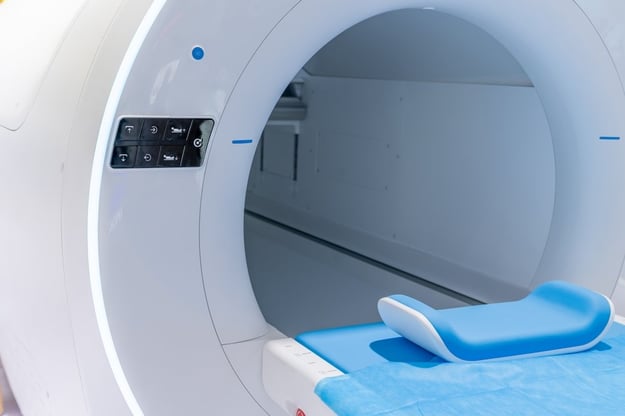
Magnetic Resonance Imaging delivers unparalleled diagnostic clarity for athletes and active individuals seeking accurate injury assessment and evidence-based treatment strategies.
“Should I wait to come in until I get an MRI?”
“Wouldn’t an MRI help explain what’s going on?”
At Revolutions in Fitness, we hear these questions every day.
Magnetic Resonance Imaging (MRI) is a powerful tool, but its role is often misunderstood. Unlike X-rays, which primarily show bone, MRIs provide a detailed view of soft tissues like ligaments, tendons, and cartilage—the structures most often involved in sports-related injuries.
Our goal is simple: help you understand when imaging is useful, and when it may not be necessary.
Would an MRI Change Your Treatment Plan?
We often assume more information leads to better decisions. But clinically, the real question is:
Would an MRI actually change what we do next?
- Are you currently a candidate for surgery?
- If imaging shows age-related changes, would that stop you from pursuing physical therapy?
If the answer is no, the MRI may be an unnecessary detour.
The value of imaging is not just having more data, but having data that is actionable.
The “Wrinkles on the Inside” Concept
One of the most important truths in physical therapy is that MRI findings do not always correlate with pain.
Think of certain findings, like disc bulges or mild meniscus tears, as “wrinkles on the inside.”
Just as wrinkles on your skin are a normal part of aging, many structural changes seen on MRI are simply part of a well-used body, not necessarily the source of your pain.
Research has shown that over 80 percent of people with no shoulder pain still demonstrate rotator cuff pathology on MRI.
Not every abnormality is the problem.
The Psychological Trap: Fixation vs. Function
Imaging can sometimes shift focus in the wrong direction.
Fixation mindset:
“My back hurts because my disc is torn. I should avoid movement.”
Functional mindset:
“My back feels tight because I’ve been inactive. I need to rebuild strength and movement.”
You are more than a diagnosis, and more than a static image.
In some cases, MRI results can create fear and limit recovery by encouraging avoidance instead of movement.
When is an MRI Actually Necessary?
MRIs are incredibly valuable when used appropriately. We typically recommend imaging in the following cases:
- Persistent symptoms that do not improve after 4–6 weeks of quality care
- Neurological deficits such as weakness, numbness, or altered reflexes
- Traumatic red flags like significant swelling or inability to bear weight
- Systemic concerns such as pain accompanied by fever, weight loss, or fatigue
The Revolutions in Fitness Approach
Before rushing to imaging, start with a movement-based assessment.
At Revolutions in Fitness, we focus on identifying the true drivers of your pain—how your body moves, compensates, and performs.
From there:
- We determine whether imaging is necessary
- We begin treatment immediately when possible
- We guide you toward the most efficient path back to performance
Even if an MRI is needed, there is almost always meaningful progress that can be made before imaging ever happens.
The Bottom Line
MRIs are a powerful tool, but they are just one piece of the puzzle.
Focus on how you move, how you perform, and how to get back to doing what you love.
With or without the picture.