
Precision in language transforms rehabilitation outcomes—discover how the difference between to and through can revolutionize your recovery journey and athletic performance.
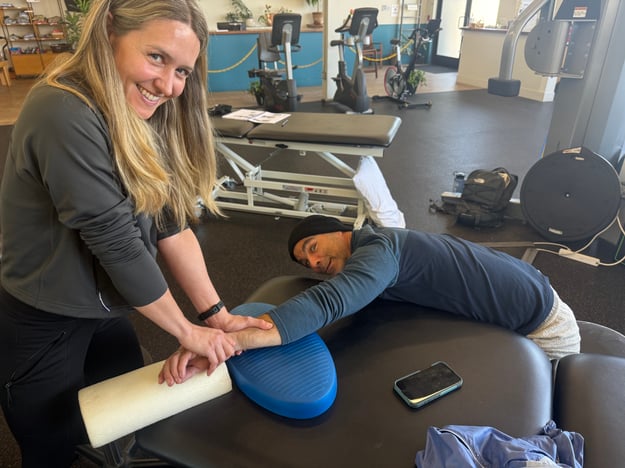
Last weekend, Sloane—one of the physical therapists who works with Revolutions in Fitness—and I were taking the IPA Upper Extremity course. One of my favorite things to do in mentorship is to retake IPA classes that I have taken before alongside physical therapists who are taking them for the first time. I always learn something new from the instructor, and it is a great way to expedite the learning of a staff member new to the class. Matt Thomason, thanks so much for teaching an amazing class. One of the things that Matt emphasized, and that I appreciate so much about the institute's work is the absolute necessity of specificity. It is one of the foundations of the work we do.
The 3x3 Matrix of Localization
Today, we are diving deeper into the "3x3 matrix" of localization blog”, which utilizes the treating hand, the assisting hand, and patient contraction to "give the body an offer it can't refuse." Our overarching goal when putting force through a tissue is to reintegrate that injured or traumatized body part back into the sensory and motor homunculus. This cortical map often becomes "smudged" after dysfunction as we instinctively avoid putting force through the stress-shielded area.
But there is a subtle art to this specificity: we must move to the dysfunction, not through it.
The Pillow & Rock Analogy: Think of the dysfunction as a rock inside a pillow. It is remarkably easy to just push down hard, squish the rock, and drive it straight to the other end of the pillow and into the bed. We don't want to barge the barrier; we want to go right up to the "door" of the dysfunction.
Applying the 3x3 Matrix: A Step-by-Step Guide
Here is a breakdown of how to apply the 3x3 matrix to ensure you are moving to the dysfunction and not barging through it:
- Step 1: Localize with the Treating Hand (Location, Depth, Direction) * Place your treating hand precisely on the dysfunction.
- Find the exact depth—aiming for the "the top of the rock," whether that is a specific fascial layer, the beginning of the lumen of an artery, or an L4 on L5 segment.
- Establish your direction, taking up the slack just up to the edge of the barrier.
- Step 2: Localize with the Assisting Hand (Moving the Extremity) * Move a peripheral body part in multiple planes (sagittal, frontal, transverse, or traction/approximation) to connect that movement directly back to the dysfunction.
- Example: If treating an anterior shear of the radial head, you might use elbow flexion or extension, combined with pronation or supination. Alternatively, this could mean moving the trunk into rotation or extension to bring the movement down to that targeted L4/L5 segment.
- How do you know if you've gone too far? Constantly monitor your treating hand. If you push or move the joint past its functional state, you will feel the joint go off-axis, compress, or feel non-optimal. Your goal is to feel the movement create a clean barrier right into your treating hand without pushing past it.
- Step 3: Localize with Contraction (Neurological and Mechanical Loading) * Add patient contraction in two to four planes (e.g., sagittal, transverse, and traction/compression). This loads up the dysfunction mechanically and neurologically, giving it that "offer it can't refuse" and creating a precise opportunity to nudge the barrier.
- Crucial Tip: "Holding" vs. "Pushing". Whenever possible, it helps to have the patient perform an isometric hold rather than a push (a maintained isotonic contraction). When a patient holds, their intention is not to move. This forces them to react to your forces and allows you to be the "conductor of the muscular orchestra." If they push, they have an active intention to move and will often default to their usual, potentially faulty, recruitment patterns. This isometric hold also increases the kinesthetic and proprioceptive challenge, forcing them to genuinely feel the forces coming into their body and react to them.
Precision Matters
If you pull or push just a little too much at any of these steps, the aggregation of forces acts like a rubber band being tugged too hard—you'll blow right past the "knot" you are trying to treat. This is especially important during non-physiological motions like joint gapping or shear.
In the video on the blog, you will see me treat Jamie's hip. Watch closely, and you will notice that at each step, I make a very conscious effort to stop the moment I feel the dysfunction arrive at my treating finger.
Specificity isn't just about where you put your hands; it's about knowing exactly when to stop. If there is one thing my mentors drilled into my head, it is this level of precision with dysfunctions that truly makes all the difference for our patients.
If you're interested in receiving more of these, please email me. I don't post all of them on the IPA Google Groups
Curtis Cramblett, PT, CSCS, CFMT, CAFS