
Standing posture, breathing, and why balance beats bracing
“Stand up straight.” “Pull your shoulders back.” “Tighten your stomach.”
We've all heard those instructions. And I've watched plenty of people follow them so enthusiastically that they end up working harder just to stand still. Their chest lifts, their lower back tightens, their stomach braces, and breathing becomes something they do around all that tension.
What if standing well didn't require so much effort?
When I look at posture, I'm less interested in whether someone looks straight in a photograph and more interested in how well they can breathe, balance, and move from that position.
Can their body accept a little pressure without collapsing somewhere? Can they shift their weight, reach overhead, or squat without having to reorganize everything first?
These are the questions that help us understand whether someone's posture is actually serving them.
Start with the Rib Cage and Pelvis, Not the Shoulders
Picture your pelvis as one block and your rib cage as another.
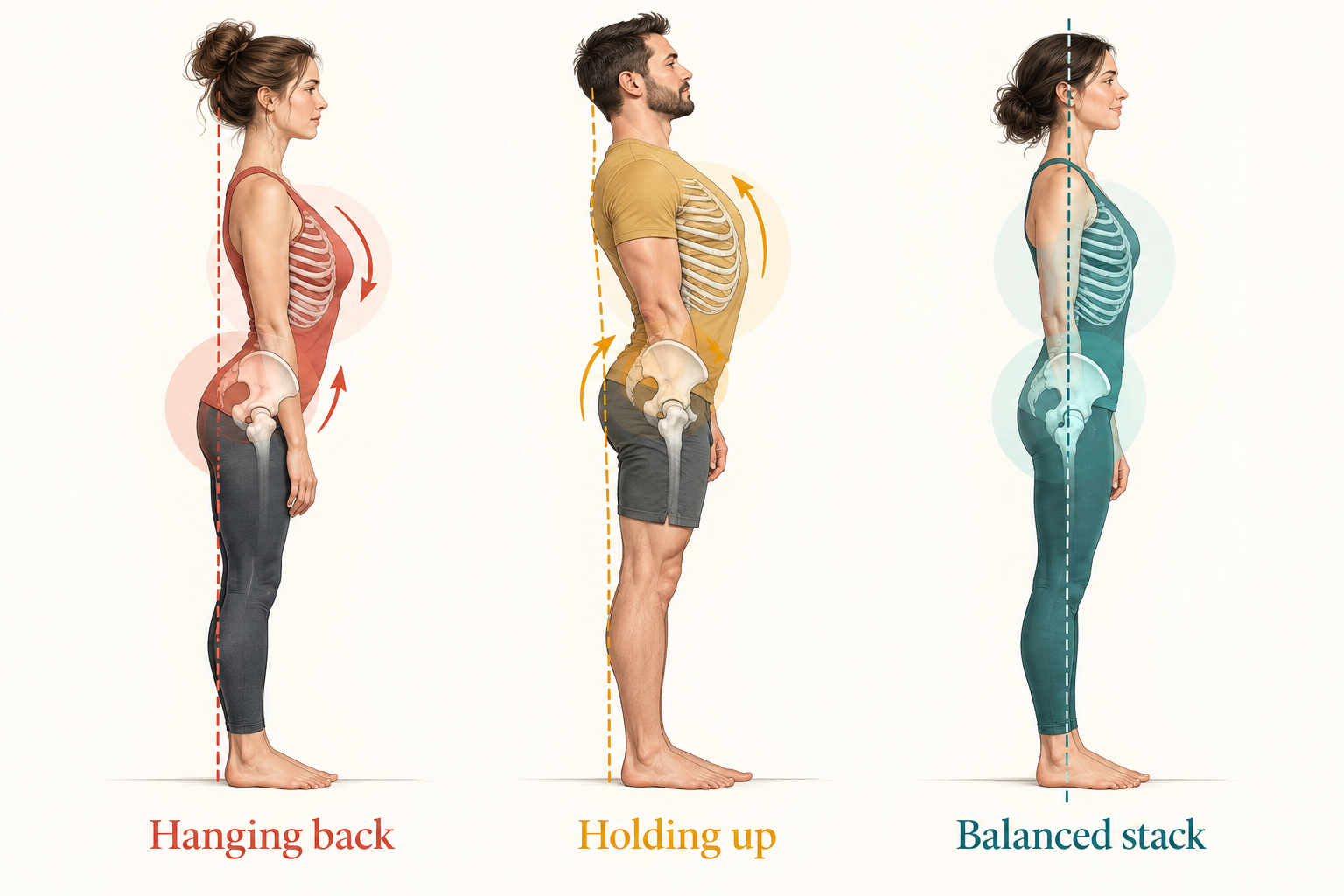
In standing, a useful starting point is to have the rib cage resting roughly over the pelvis, rather than hanging behind it or being pushed far out in front.
We call this vertical stacking—or, in the Saliba Postural Classification System used in Functional Manual Therapy, Vertical/Vertical.
The goal is not to make the spine perfectly straight. Your spinal curves are normal, and everybody is built a little differently.
The idea is to create a position in which your skeleton provides a comfortable base of support and your muscles are available for movement rather than constantly holding you up.
Think about stacking blocks. When they're balanced over one another, they require very little effort to remain upright. When one block shifts forward or backward, something else has to compensate to prevent the whole structure from falling.
Our bodies are considerably more sophisticated than a stack of blocks, but the principle is useful.
When our rib cage and pelvis are reasonably aligned, we may be able to distribute forces more effectively and reduce unnecessary muscular effort.
That relationship matters to breathing, too.
Your diaphragm sits inside the lower rib cage; your abdominals surround the trunk; and your pelvic floor forms part of the bottom of that system.
If you're always thrusting your ribs up or collapsing them down, it may be harder to coordinate that system comfortably.
But the answer is rarely to brace harder.
Often, the first step is simply learning to find a better place to start.
Two Common Ways We Get Off Our Stack
There are many variations in standing posture, but two patterns are particularly useful to recognize.
1. Hanging Back
One common pattern is what I call hanging back.
The pelvis drifts forward, the rib cage sits behind it, and the upper trunk may tip forward.
People often feel relaxed in this position because they're resting into the support of their joints and passive tissues rather than actively organizing themselves over their feet.
But relaxed doesn't necessarily mean efficient.
When someone in this position reaches, lifts, or accepts a load, they may compensate by hinging through a relatively small area of the lower back or shifting excessively through the hips.
The body finds a way to accomplish the task, but it may have fewer movement options available.
2. Standing at Attention
The second pattern is almost the opposite.
This is the person who has been told to stand up straight and takes that instruction very seriously.
Their chest lifts, shoulders pull back, lower back arches, and ribs tip upward.
At first glance, this may look like excellent posture.
But look a little closer.
Are they breathing comfortably? Can they relax their abdominal muscles? Can they bend forward or raise their arms without exaggerating the arch in their lower back?
Sometimes what looks like good posture is actually a tremendous amount of muscular effort.
Good posture should not require you to constantly hold yourself in position.
Neither of these patterns is inherently bad, and neither automatically means someone will experience pain or spinal degeneration.
They are simply strategies the body has learned.
The question is whether those strategies are helping or limiting the person's ability to move.
Finding Your Vertical Stack
Now let's explore what a more balanced standing position might feel like.
I encourage you to try this rather than simply reading about it.
You may be surprised by how small the adjustments need to be.
Step 1: Find Your Happy Place on Your Feet
Stand with your feet comfortably apart.
Slowly shift your weight forward toward your toes, then backward toward your heels.
Notice how your body responds.
When you move too far forward, your toes may grip and your calves may tighten.
When you move too far backward, you may feel yourself hanging on your heels, with your pelvis shifting forward to compensate.
Now find a comfortable place somewhere between those extremes.
I often call this finding your happy place on your feet.
You should feel supported without having to work excessively to stay upright.
Step 2: Unlock Your Knees
Allow your knees to soften slightly.
You don't need to bend into a squat, and you don't need to tuck your pelvis aggressively.
Simply avoid pushing your knees backward and locking yourself into position.
Notice whether your pelvis can settle more comfortably over your legs.
Step 3: Bring Your Rib Cage Over Your Pelvis
This is where the magic often happens.
Without lifting your chest or sucking in your stomach, gently bring your rib cage into a position above your pelvis.
Sometimes a comfortable exhale helps.
Let the lower ribs soften and settle.
Imagine the rib cage and pelvis as two blocks finding their balance.
You aren't trying to flatten your back or eliminate its natural curves.
You're simply looking for a position where your body doesn't have to work quite so hard to hold itself upright.
Step 4: Breathe
Once you've found this position, take a few comfortable breaths.
Can you feel your lower rib cage expand?
Can you breathe into the sides and back of your ribs?
Does your abdomen move naturally?
If you have to tighten your stomach or hold your breath to maintain the position, you've probably gone too far.
A good starting posture should make breathing feel available, not restricted.
Step 5: Let Your Head and Shoulders Come Along for the Ride
Rather than pulling your shoulders back, allow them to rest comfortably.
Look straight ahead and gently lengthen through the back of your neck.
Your head should feel balanced rather than held rigidly in position.
You may notice that when your rib cage and pelvis are better organized, your head and shoulders naturally find a more comfortable position without much effort.
Now Comes the Important Part: Test It
This is where I think posture becomes truly interesting.
Finding a position that looks better is one thing.
Finding a position that helps you function better is something entirely different.
Before changing your posture, try a simple movement.
Raise both arms overhead.
Turn your head to look over each shoulder.
Take a comfortable deep breath.
Or perform a small squat.
Notice how the movement feels.
Now find your vertical stack and repeat the same movement.
What changed?
Did your arms move more easily?
Did your neck turn farther?
Was breathing more comfortable?
Did your squat feel more balanced?
Sometimes the difference is immediate.
Other times, very little changes.
And occasionally, the new position may actually feel worse.
That's useful information, too.
It may mean that your body doesn't yet have the mobility, stability, or coordination to comfortably access that position.
For example, restrictions in your rib cage, hips, feet, or spine may influence how easily you can organize yourself in standing.
This is why we don't simply tell everyone to stand up straight and send them home.
In Functional Manual Therapy, we can use assessments such as vertical compression testing and functional response testing to help understand how the body manages forces and whether a particular adjustment improves function.
We look at the entire system rather than focusing on one isolated body part.
The Goal Isn't to Hold Perfect Posture All Day
Here's something I want to make very clear.
I am not suggesting that you should spend your entire day thinking about your posture.
That would be exhausting.
And I don't believe there's one perfect position that everyone should maintain all the time.
Your body is designed to move.
You should be able to slouch, bend, twist, relax, reach, and change positions throughout the day.
The problem isn't that we occasionally move out of alignment.
It's that we sometimes lose the ability to move comfortably between different positions.
Vertical stacking gives us a useful starting point.
From there, we want to develop the ability to move in and out of that position naturally.
Try finding your stack and then reaching overhead.
Find your stack and perform a squat.
Find your stack and shift your weight from one foot to the other.
Then walk away and forget about it for a while.
Come back later and see whether you can find that balanced position again.
Over time, the goal is for your nervous system to recognize efficient movement strategies without requiring constant conscious correction.
Posture Is About Possibilities, Not Perfection
One of the things I've learned through years of working with patients is that the body is incredibly adaptable.
We all develop movement habits based on our experiences, injuries, activities, and the demands of daily life.
Some of those habits serve us well.
Others may become limiting over time.
But the answer is rarely as simple as telling someone to stand differently.
We need to understand why their body has chosen a particular strategy and whether they have other options available.
Sometimes that means improving mobility.
Sometimes it means developing strength or coordination.
Sometimes it means addressing restrictions through hands-on treatment.
And sometimes it simply means helping someone become aware of a more comfortable way to organize their body.
At Revolutions in Fitness, we combine these approaches to help people move with greater ease and confidence.
We aren't trying to make everyone look the same.
We're trying to help each person discover how their body works best.
A Final Thought
The next time someone tells you to stand up straight, consider a different approach.
Instead of lifting your chest, pulling your shoulders back, and tightening your stomach, see if you can find a comfortable balance between your feet, pelvis, and rib cage.
Take a breath.
Move a little.
Notice what changes.
You may discover that standing well has less to do with holding yourself in the right position and more to do with allowing your body to find support without unnecessary effort.
The goal isn't a prettier posture. It's a body that moves better, breathes easier, and gives you more freedom to do the things you love.
Want to Learn More?
If you're struggling with persistent discomfort, stiffness, or difficulty finding a comfortable standing position, the team at Revolutions in Fitness can help.
Through individualized assessment, Functional Manual Therapy, and movement training, we work to identify the limitations that may be preventing your body from moving as efficiently as it could.
Our goal is to help you build the mobility, stability, and coordination needed for the activities that matter most to you.
Revolutions in Fitness — Helping You Move Better, Feel Better, and Live Better.
Acknowledgment: This article was inspired in part by Pete Rumford's discussion of standing posture and alignment, published by IPA Physio, and by the Saliba Postural Classification System taught through the Institute of Physical Art.
Research note: Although posture can influence movement strategies and how forces are distributed through the body, research has not established a consistent causal relationship between any single standing posture and low-back pain or spinal degeneration. Individual variation, movement capacity, and symptoms should guide assessment and treatment.