
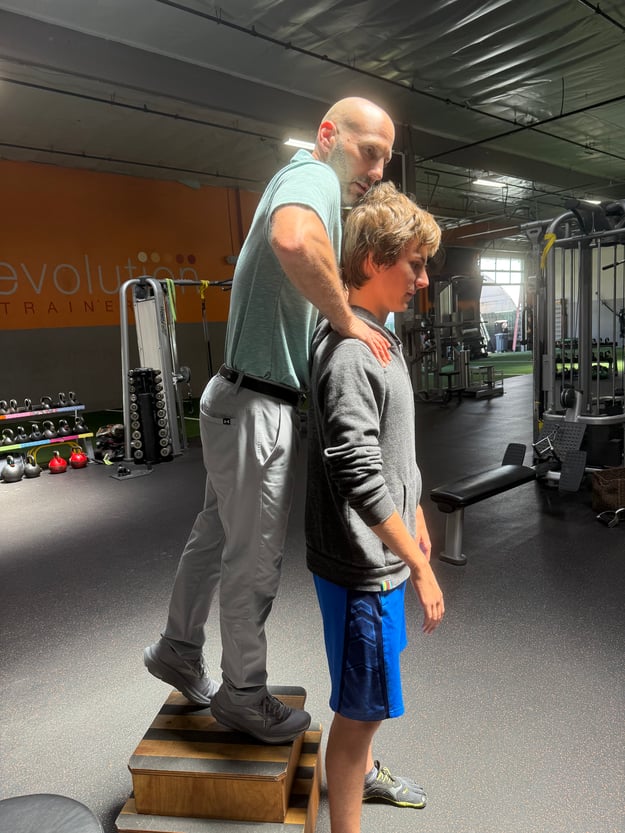
Discover how the vertical compression test can reveal hidden spinal issues affecting your posture, performance, and movement quality.
The Posture Trap: Why Looking "Straight" Doesn't Always Mean Strong
Most of us grew up hearing the same advice:
"Stand up straight."
"Pull your shoulders back."
"Sit up tall."
The problem is that many people can force themselves into what looks like "good posture" while their body is working incredibly hard behind the scenes. They may look aligned from the outside, but internally they're relying on excessive muscle tension, holding patterns, and compensation strategies that can contribute to stiffness, fatigue, and even pain.
At Revolutions in Fitness, we're less interested in how your posture looks and more interested in how your body functions under load.
The Real Question: Is Your Posture Actually Strong?
Imagine two people standing side by side.
One appears perfectly upright with their chest lifted and shoulders pulled back. The other looks more relaxed and natural.
Which one has better posture?
The answer is: we don't know.
That's because posture isn't about appearance. It's about how efficiently your body transfers force through the skeleton and manages the demands placed upon it throughout the day.
This is where the Vertical Compression Test becomes incredibly valuable.
What Is the Vertical Compression Test?
The Vertical Compression Test (VCT) is one of our favorite assessment tools because it gives immediate feedback about how efficiently your body is organized.
During the test, gentle downward pressure is applied through your shoulders while you're standing. The goal isn't to test strength. Instead, we're evaluating how effectively your body transfers force from the top of your body through your trunk, pelvis, legs, and into the ground.
When everything is well organized, the pressure flows smoothly through your body. You feel stable, balanced, and surprisingly strong.
When things aren't aligned efficiently, that same gentle pressure may create feelings of strain, instability, pinching, wobbling, or excessive muscle tension.
In just a few seconds, the test can reveal whether your body is working with gravity or fighting against it.
The Soda Can Principle
One way to understand the Vertical Compression Test is to think of your torso like a soda can.
An unopened soda can is remarkably strong because the top and bottom are aligned and the pressure inside is evenly distributed.
Your body functions in a similar way.
When your rib cage is balanced over your pelvis, your diaphragm and pelvic floor work together to create natural internal pressure that supports your spine. Your body becomes efficient because the load is distributed throughout the entire system.
But when the rib cage shifts forward, backward, or becomes disconnected from the pelvis, that pressure system loses efficiency. Suddenly your muscles have to do extra work just to hold you upright.
The Vertical Compression Test helps us identify when that system is functioning well and when it's not.
Why Patients Love This Test
One of the reasons we use the VCT so often is because it's something patients can feel immediately.
Many people spend years being told they have poor posture. They've tried sitting up straighter, squeezing their shoulder blades together, tightening their abs, or buying posture braces.
Then we perform a Vertical Compression Test.
After making a small adjustment—whether through manual therapy, positioning, breathing strategies, or movement cues—we test again.
The difference is often dramatic.
Patients frequently feel stronger, more stable, and more comfortable within minutes. Instead of being told they are better aligned, they can actually feel the difference for themselves.
Stop Chasing Perfect Posture
The goal isn't to walk around all day trying to maintain a rigid position.
The goal is to help your body find a position where stability happens naturally.
At Revolutions in Fitness, we use the Vertical Compression Test to identify inefficient patterns and guide treatment decisions. By combining hands-on manual therapy, movement retraining, and authentic movement cues, we help your body rediscover the balance and efficiency it was designed to have.
When your body is organized well, standing feels easier. Walking feels smoother. Movement requires less effort. And many people discover that they can finally stop obsessing about posture and simply get back to living.
Because the best posture isn't the one that looks perfect—it's the one that allows your body to function effortlessly.