
Discover how isometric exercises can strengthen your joints, reduce pain, and accelerate recovery without placing stress on vulnerable tissues.
Don’t Move. Improve More.
How “No-Movement” Exercises Can Accelerate Healing and Performance
If you’re someone who wants to stay strong, active, and injury-free well into your 50s, 60s, and beyond, here’s a counterintuitive idea: sometimes the fastest way forward is to stop moving—at least briefly. A growing body of research, along with insights from leading physiologists, is pointing toward the power of isometric exercises—those “hold” positions where muscles are working without visible movement—as a highly effective way to reduce pain, improve tendon health, and restore strength. This isn’t about doing less. It’s about doing the right kind of work at the right time.
Let’s start with your connective tissue—your tendons, ligaments, and joint-supporting structures. These tissues don’t respond well to being completely unloaded. In fact, when we remove stress entirely (think prolonged rest or immobilization), we can create what’s called stress shielding. The stronger parts of a tendon take over, while weaker or injured areas are bypassed. Over time, this leads to disorganized healing—what many people experience as lingering stiffness, pain, or re-injury.
The solution isn’t aggressive movement. It’s precise, controlled loading—and this is where isometrics shine. By holding steady tension, we allow load to distribute more evenly across the tissue, giving those underused areas a chance to re-engage and heal properly.
The Hidden Power of Holding Still
There’s also an important timing effect at play. When you hold an isometric contraction, something called temporal summation occurs—but not in the simplified sense of “more time equals more signal.” What actually happens is more interesting: as you hold a position, the muscle fibers doing most of the work begin to fatigue. As they fatigue, the body is essentially forced to recruit additional fibers—parts of the muscle that may have been relatively underused or even “shielded.”
In other words, those quieter parts of the system are given an offer they can’t refuse.
Over time, this leads to more complete muscle activation and more evenly distributed load across the tendon and muscle system—exactly what we want for healing and resilience.
But the benefits don’t stop at the tendon. Isometric exercises also have a powerful effect on your nervous system. Holding tension increases motor unit recruitment, meaning more muscle fibers are activated simultaneously. This is especially important for muscles that tend to “go offline” over time, like the deep stabilizers of your spine—particularly the multifidus.
In many cases, the issue isn’t just weakness—it’s disconnection. The brain has simply stopped communicating effectively with certain muscles. Through isometric work, we begin to rewire those pathways, leveraging the brain’s natural ability for neuroplasticity.
What the Research Shows
This is particularly relevant for low back pain, where research shows that both isometric and dynamic (isotonic) exercises can reduce pain and improve function—but isometrics may offer a slight edge, especially early in the process.
A 2024 randomized controlled trial published in Anesthesiology and Pain Medicine compared isometric (ISOM) and isotonic (ISOT) core stabilization exercises in patients with non-specific chronic low back pain (NSCLBP). The study involved 41 men and women who were randomly assigned to either an ISOM group, an ISOT group, or a waitlist control group. Exercise sessions were performed three times per week for up to eight weeks.
The results showed:
- Both ISOM and ISOT groups significantly reduced pain and disability
- The isometric group demonstrated numerically better outcomes
- VAS pain scores dropped from 5.5 to 2.7 in the ISOM group
- ODI disability scores improved from 17 to 11 in the ISOM group
- Both exercise groups outperformed the control group significantly
The authors concluded that both approaches are effective for chronic low back pain, but isometric exercises may provide a modest advantage.
Study Reference
Khaledi A, Gheitasi M.
Isometric vs Isotonic Core Stabilization Exercises to Improve Pain and Disability in Patients with Non-specific Chronic Low Back Pain: A Randomized Controlled Trial.
Anesth Pain Med. 2024;14(1):e144046.
👉 https://doi.org/10.5812/aapm-144046
Building a Stronger Foundation
These exercises target deep, postural muscles that are essential for spinal stability but often under-recruited. Movements like bridges, side planks, and controlled holds allow us to activate these muscles without aggravating sensitive tissues. Over time, this builds a more resilient foundation for movement—whether you’re cycling, golfing, hiking, or simply living well.
At Revolutions in Fitness, we integrate these principles into a broader, individualized plan. Isometrics are often a starting point—a way to restore connection, reduce pain, and prepare the body for more dynamic work. From there, we progress into movement, strength, and endurance. Think of it as rebuilding your system from the inside out: first reconnect, then reinforce, then perform.
Influential thinkers like Rick Jemmett (The New Science of Low Back Pain, 2nd Edition) and Stuart McGill (Back Mechanic) have long emphasized the importance of spinal stability and controlled loading—and we’ve found their work aligns closely with what we see clinically.
- Rick Jemmett’s book:
https://www.amazon.com/dp/0969758124 - Stuart McGill’s book:
https://www.backfitpro.com/books/back-mechanic/
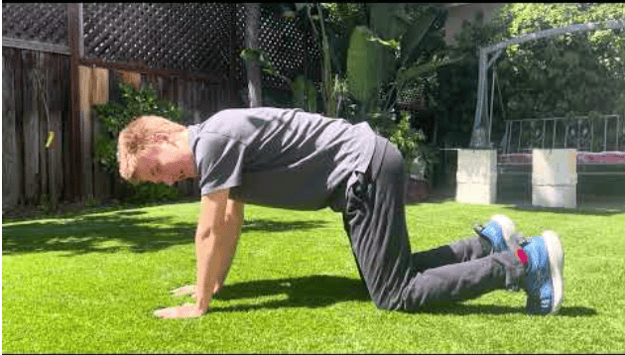
Watch Waylon Demonstrate Three Powerful Exercises Below
Final Thoughts
If you’re dealing with a stubborn injury—or simply want to maintain peak capacity as you age—don’t overlook the power of stillness. Done correctly, these “no-movement” exercises can help you move better, feel stronger, and stay active longer.
And if you’d like guidance on how to apply them safely and effectively, we’d be happy to walk you through it.