Prolonged sitting is silently sabotaging your musculoskeletal health, increasing pain, stiffness, and injury risk—but strategic movement throughout your workday can reverse the damage.
As a physical therapist—and someone who has personally dealt with both cervical and lumbar disc herniations—I have a particular appreciation for what prolonged, static positions can do to the body.
One of the most common questions I hear is: “What is the best posture for sitting at my desk all day?”
My answer usually isn't another ergonomic rule about where your shoulders, hips, or monitor should be. It's this:
Your best posture is probably your next posture.
The human body is built for movement and variation. Sitting isn't inherently bad, and standing isn't inherently good. The bigger problem is spending hours in essentially the same position. Research suggests the consequences of prolonged sitting aren't limited to your back and neck. Extended inactivity can influence blood flow, glucose regulation, cerebral oxygenation, and cognitive performance.
Your Spine Doesn't Love Static Loading
When you're sitting for long periods—particularly in a relaxed or slouched position—the tissues of the spine are exposed to sustained mechanical loading.
Intervertebral discs also have a very limited direct blood supply. Movement and changes in mechanical loading contribute to the movement of fluid and nutrients through the disc.
That doesn't mean sitting automatically causes a disc injury. It does mean movement and changes in position are normal parts of maintaining healthy spinal tissue.
If you've been sitting in the same position for two hours, the answer may not be adjusting your lumbar support another half inch. The answer may simply be to get up and move.
Your Brain May Benefit From Movement Breaks, Too
Researchers have looked at what happens to cognitive performance when prolonged sitting is interrupted with short bouts of activity—from light walking and standing to resistance exercises and stair climbing.
The emerging evidence suggests that periodically breaking up prolonged sitting can have small but meaningful acute effects on certain aspects of cognitive performance, including executive function.
We're not saying a two-minute walk suddenly makes you smarter. Instead, movement may help counter some of the decline in alertness and cognitive performance that can develop during long periods of uninterrupted sedentary work.
Think of it as routine maintenance for your brain and body.
Executive function helps you switch between tasks, ignore distractions, make decisions, organize information, and maintain goal-directed behavior. Working memory allows you to temporarily hold and manipulate information while solving a problem or completing a complex task.
These are exactly the mental skills many of us expect to perform at a high level for eight or more hours every workday—often while barely moving.
Blood Flow May Be Part of the Explanation
When you're inactive for prolonged periods, the muscles of your lower legs aren't contracting very much. That's important because your calf muscles function as a type of muscle pump, helping move venous blood from the lower extremities back toward the heart.
When you stand and walk, those rhythmic muscular contractions become active again.
Research published in 2024 also reported that prolonged sitting reduced cerebral oxygenation during an executive-function task in physically active young adults.¹ This doesn't mean your brain is dangerously deprived of oxygen every time you sit at your computer. It adds to evidence suggesting that remaining physically inactive for hours at a time isn't an ideal physiological state—even if you exercise regularly.
Movement Helps Your Metabolism, Too
There's another reason to get out of your chair: blood sugar regulation.
In a study published in Diabetes Care, researchers compared prolonged uninterrupted sitting with sitting that was regularly interrupted by brief activity. Participants who performed two minutes of light- or moderate-intensity walking every 20 minutes had lower post-meal glucose and insulin responses than when they remained sitting continuously.²
You don't need a workout for this effect. Contracting skeletal muscle requires energy. Getting up and moving gives your muscles an opportunity to use circulating glucose rather than remaining almost completely inactive for hours after a meal.
That's particularly relevant to the familiar afternoon pattern:
Lunch → Sit down → Don't move → Energy crash.
A short walk after lunch may be doing considerably more for you than simply providing a mental break.
Do You Really Need to Get Up Every 20 Minutes?
You'll frequently see recommendations to set a timer and stand or walk every 20–30 minutes. Physiologically, frequent interruptions to prolonged sitting make sense.
But deep work requires concentration. If you're halfway through writing something complicated or solving a difficult problem, an alarm telling you to walk around can become another distraction.
I prefer a more practical strategy: move at natural transition points.
- Finish a section → stand up.
- Finish a meeting → walk for two minutes.
- Send the report → refill your water.
- Finish lunch → take a short walk.
- Take an audio-only call → stand or walk.
Use the natural transitions already built into your workday as movement triggers.
The Answer Isn't Standing All Day
When people hear that prolonged sitting isn't ideal, the immediate response is often: “I'll get a standing desk.”
That's useful, but it isn't the complete solution. Replacing eight hours of sitting with eight hours of motionless standing simply gives you a different static position.
The goal should be movement variability.
A good workstation should allow you to sit, stand, walk, lean, change your foot position, rotate your trunk, move your shoulders, and periodically get away from the desk.
There isn't one magical posture your body needs to maintain for eight hours. Your body wants options.
What If You Can't Leave Your Desk?
Some days are packed. That's where micromovements can be useful:
- Calf raises
- Seated knee extensions
- Gentle trunk rotations
- Standing during an audio call
- Shifting between sitting and standing
- Walking while thinking through a problem
- Taking the stairs between meetings
- Moving your shoulders and upper back
These aren't replacements for exercise or meaningful walking, but they're better than complete muscular inactivity for hours at a time.
But I Exercise Every Morning. Isn't That Enough?
Your workout absolutely matters. A morning ride, run, strength session, or gym workout improves fitness, strength, and cardiovascular capacity.
But getting enough exercise and avoiding excessive sedentary time aren't necessarily the same thing.
You can train hard for an hour every morning and still spend most of the remaining day almost completely inactive. That doesn't erase the benefits of your workout. It means your movement strategy shouldn't end when your workout ends.
A Better Workday Movement Strategy
You don't need to turn your office into a gym.
Change positions frequently. Sit for a while. Stand for a while.
Move at natural breaks. Finished a call? Walk. Finished a project section? Stand up.
Walk after meals when possible. Even a short walk gets large muscles contracting again.
Use phone calls as movement opportunities. If you don't need the screen, get away from it.
Keep exercising. Movement breaks complement structured exercise; they don't replace it.
And perhaps most importantly, stop trying to find the perfect posture. Build a work environment that allows you to change posture.
Movement Is Maintenance
We tend to separate our workday from our physical health. We exercise before work, sit down at 8:00, and then expect our body and brain to perform continuously until 5:00.
But your physiology doesn't know that you're “at work.”
Your muscles still need to contract. Your joints still need movement. Your cardiovascular system still responds to activity. Your metabolism still has to manage the meal you just ate. And your brain still depends on the rest of your body to function.
The goal isn't to stop sitting. The goal is to stop being motionless for hours at a time.
Your morning workout matters. Your workstation matters. Your posture matters. But so does what you do during all those hours between workouts.
Sit. Stand. Walk. Change positions. Then change them again.
Your next posture may be more important than your perfect posture.
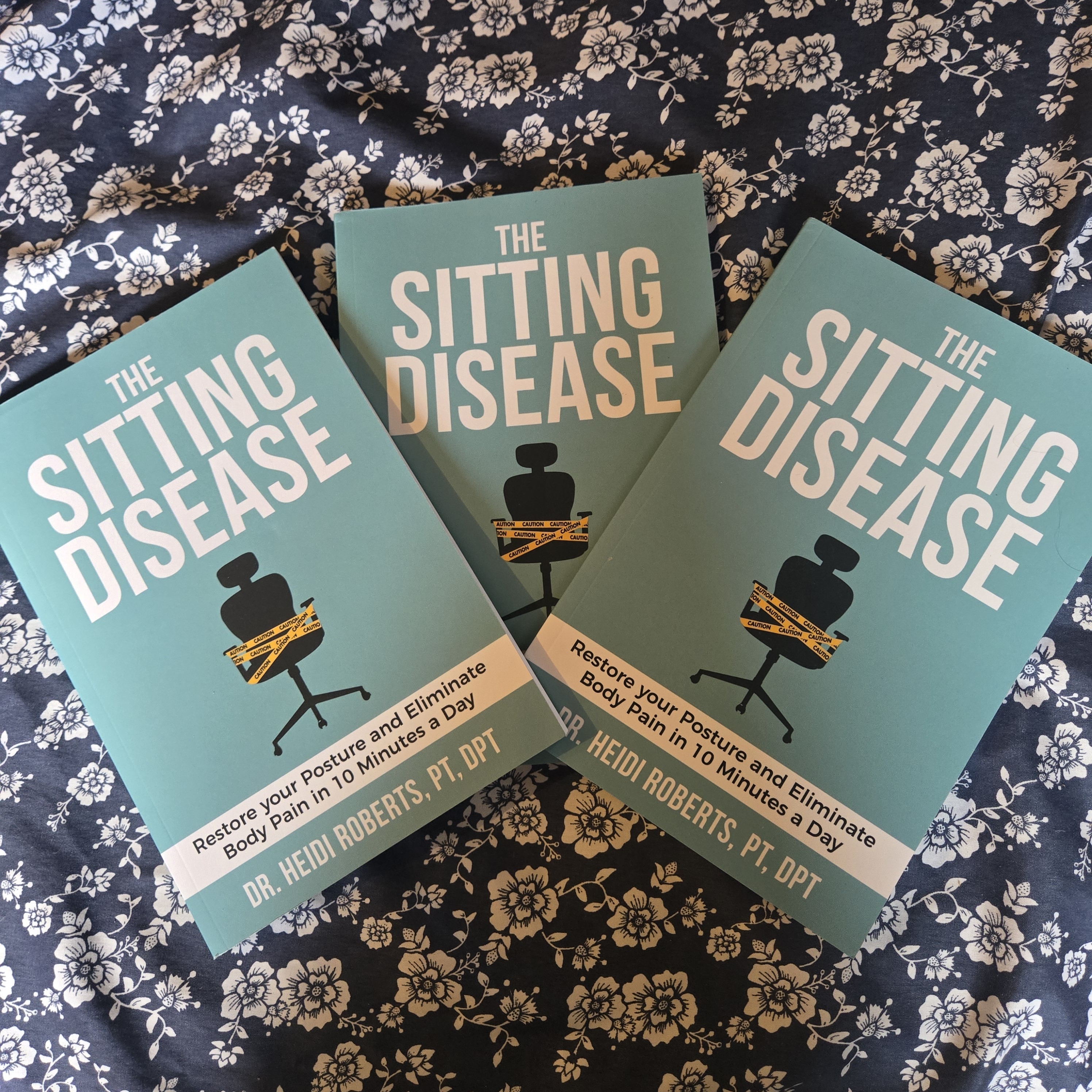
Leave Us a Google Review To Be Entered To Win A Copy Of
"The Sitting Disease"
by Dr. Heidi Roberts, PT, DPT